Birds & Solar Panels: How to Stop Pests from Ruining Your System
By Adam, Founder, CleanMySolarPanels · March 27, 2026 · Updated October 29, 2026
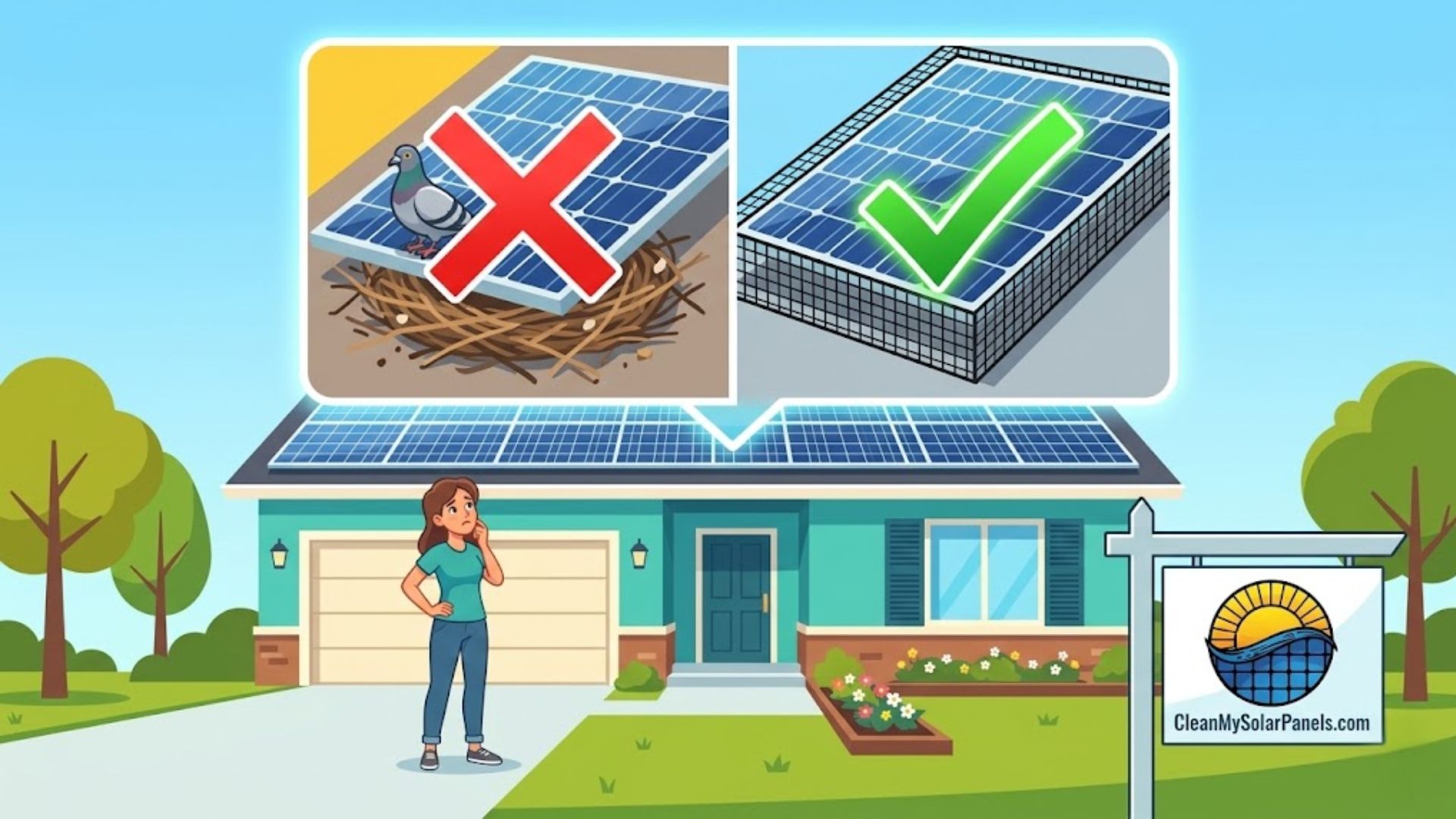
The way to stop birds and squirrels ruining a rooftop solar system is to clean out whatever is already under the panels, then close the gap with PVC-coated steel mesh clipped to the panel frames, with no drilling and no roof penetration. A 100 ft roll of critter guard costs $44–$79, and a pro fits it in the same visit as a cleaning. Where pigeons nest, the droppings alone cost more output than NREL's typical 5% soiling loss.
Pigeons do not pick your roof by accident. The 4 to 6 inch gap under a rooftop array is shaded, warm, dry and out of reach of hawks and cats. Once a pair settles in, the flock grows, and the problem moves from white streaks on the glass to droppings that etch the coating, nests that block drainage, and chewed wiring that can start a fire.
This guide covers why they come, what the damage looks like, how a proper bird proofing job is done, the humane and legal rules, why spikes, decoys and ultrasonic gadgets fail, and which of the 91 cities this directory covers see the heaviest pressure.
Why pigeons and squirrels nest under solar panels
Rooftop panels sit on rails a few inches above the shingles so air can flow underneath and keep the cells cool. To a pigeon that gap is a covered ledge: rain cannot reach it, the panel radiates heat through cold nights, and the opening is too low for a hawk or a neighbourhood cat to follow.
Pigeons are loyal to a site. A pair that raises one brood under your array comes back for the next, and their young nest nearby. A colony is rarely two birds for long, and a cleaning without mesh buys only a few weeks.
Squirrels and roof rats use the same gap, with one extra draw. Rodents gnaw to keep their teeth short, and the insulation on PV wiring is soft, warm and within reach. Nests of twigs and dry leaves packed around that wiring are the fire risk in this story.
What bird droppings do to a solar panel
Rain rinses dust; it does not rinse guano, and the longer it stays the more it costs you.
- Hot-spot shading. A patch of droppings shades a few cells. The rest of the string pushes current through them, they heat up, and over months that heat can damage the cell permanently. One shaded cell throttles the whole string, so output drops far more than the size of the patch suggests.
- Etched anti-reflective coating. Droppings are acidic. Baked onto hot glass through a summer, they leave a dull patch that no cleaning restores.
- Warranty risk. Performance warranties assume reasonable maintenance. Months of visible droppings before a hot-spot failure is the kind of history a claims department notices.
- Lost output. NREL puts typical soiling losses at around 5% a year, 7% in dusty climates, 10% to 15% during pollen season and up to 25% in the dustiest regions. A roost sits on top of that, because the droppings land in the same place every day.
Nest debris adds two more problems. Packed twigs and leaves dam the water that should run off the roof, so it pools around the mounting feet and flashing, and that is how a sound roof starts to leak. The same dry material pressed against chewed wiring is kindling.
How to tell you have a problem
You do not need to go up on the roof. Four signs give it away.
- Noise at dawn. Pigeons start cooing and scuffling as the light comes up. If you hear it through an upstairs ceiling, they are under the array, not on the ridge.
- Streaks on the glass. White or grey runs that start at the top edge of a panel and fan down are droppings from birds perched above. Our guide to the signs your solar panels need cleaning has the full eye test.
- A drop on the monitoring app. Enphase, SolarEdge and Tesla apps show production per panel. Uniform dust lowers the whole array together; a nest shows as one or two panels well below their neighbours on clear days, week after week.
- Debris at the array edge. Twigs, feathers and droppings along the bottom frame, or in the gutter directly below, are coming from under the array. Nest material does not blow in from the street.
All four means the colony is established. One or two means you have caught it early, and early is cheap.
The fix: clean out first, then close the gap with mesh
Bird proofing is a two-step job, and the order matters. Mesh over an occupied nest seals birds, eggs and droppings inside, which is illegal for protected species and a guaranteed smell. The clean-out comes first, the guard goes on the same day, and the glass is washed last.
Step 1: the clean-out
A pro lifts out nests and droppings by hand or with a hooked pole, bags the material, and wets heavy droppings first so dust does not go airborne. Purdue Extension notes that accumulated pigeon droppings can harbor the organism that causes histoplasmosis, a lung infection caught by breathing the spores, which is why dry sweeping a roost is wrong. Gloves, a fitted respirator and a damp-down are standard.
The pro also checks the wiring. Chewed insulation or a loose connector gets photographed and flagged for an electrician; a cleaner does not open junction boxes and neither should you. Panels produce DC whenever light hits them, and REC's cleaning guide warns that damaged panels present a shock hazard that rises when wet. A routine cleaning does not need the system shut down, but a repair does; our guide on turning the system off explains who throws which switch.
Step 2: the critter guard
The guard is a strip of PVC-coated galvanised steel mesh, usually 6 inches wide, with openings of half an inch to an inch. It runs around the full perimeter of the array, bent to follow the gap between frame and roof, and is held on with clips that grip the panel frame. Nothing is drilled and nothing goes through the roof; a hole in a panel frame or a new roof penetration is the fastest way to lose both the module warranty and the roofing warranty.
Three guard kits are on our gear pages:
- Bird B Gone Solar Panel Mesh, 6 in x 100 ft roll, $79, the brand most pros carry.
- Solar Panel Bird Guard Kit, 6 in x 100 ft with 70 clips, $48.
- YESON Solar Panel Guard, 6 in x 100 ft roll kit, $44.
A 20-panel array in two rows of ten has a perimeter of roughly 90 ft, so one 100 ft roll covers most home systems. Check the gauge: thin uncoated wire rusts in one wet season and bleeds orange down the shingles, and squirrels chew through plastic mesh in a week. PVC-coated 20-gauge steel or heavier is the standard.
Clip spacing. Pros fit one clip every 8 to 12 inches, one at each corner, and one either side of any cut-out for a conduit. Fewer clips and the mesh bellies out in wind, and a pigeon walks through a two-inch sag. Corners are folded closed, because a gap at a corner is a door.
Step 3: wash the glass
With the gap closed, the panels get a proper clean: purified water and a soft brush on a water-fed pole, worked from the ground or a harness, never from the glass itself. Baked-on droppings need a soak first; the Absolutely Clean Bird Poop Remover, a $16 enzyme spray, softens dried guano so the brush lifts it without scrubbing. Our guide to cleaning solar panels like a pro covers the method, and why pressure washers, vinegar and dish soap stay off the roof.
Ground-mount arrays need skirting, not a perimeter guard
A ground mount is open underneath, so birds rarely nest there. The problem is rabbits, ground squirrels and rats chewing the cable runs where they drop to the trench. The fix is skirting: a band of the same coated mesh from the lower edge of the array to the ground, buried a few inches so nothing digs under. Low-clearance mounts and closed-back carports are treated like a roof array.
DIY or pro: who should fit the guard
A careful homeowner can fit mesh on a single-storey, low-pitch roof. The limits are height, pitch and what is already under the array.
| Question | DIY mesh install | Pro install with cleaning |
| Material | $44–$79 for a 100 ft roll and clips | Same coated steel mesh, priced per linear foot of array perimeter |
| Best for | Single-storey, low pitch, no active nest | Two-storey, steep roof, or an established colony |
| Clean-out | You handle droppings and nest material yourself, with respirator and gloves | Done the same visit, bagged and removed |
| Fixings | Frame clips; never screws or drilled holes | Frame clips; a pro will refuse to drill |
| Wiring check | Visual only; call an electrician for anything chewed | Photographed and flagged for repair |
| Warranty | Safe if nothing is pierced; your photos are the record | Before-and-after photos supplied |
| Typical price | Materials only | Quoted per foot, usually bundled with a $110–$320 cleaning |
Pros price critter guard by the linear foot of perimeter, and most quote it only alongside a cleaning because the clean-out is half the work. Ask for the per-foot rate, the perimeter they measured, and whether the wash is included. City pages on this site show which local pros list bird proofing as a service; Los Angeles has 22 pros listed and Phoenix has 23. You can also request quotes from local pros.
If you go up yourself, the roof is the risk, not the mesh. OSHA requires fall protection at six feet in construction, and a pitched roof with an array on it is what that rule exists for. A harness and anchor kit such as the Malta Dynamics Warthog, $71, costs less than one pro visit; a second person on the ground is free. Walking on the panels is never part of the job, and our two-storey guide makes the case for hiring that roof out.
The humane and legal rules
Bird proofing done badly is cruel and, for most species, a federal offence. Four rules keep it right.
- Never seal birds, chicks or eggs in. Mesh over an occupied nest kills whatever is inside. The guard goes on only once the gap is empty.
- Know what you are looking at. The Migratory Bird Treaty Act protects native birds and prohibits taking them without a permit. The federal list of species it does not cover is the nonnative, introduced birds: rock pigeons are named on it, and house sparrows and European starlings are excluded by family. Those three are the usual tenants under an array, and their nests can be removed. Gulls, swallows, finches, grackles, mourning doves and nearly every other wild bird are protected, and an active nest must be left until the young have fledged.
- Work outside nesting season where you can. Pigeons breed year-round in warm cities, but for protected species late summer to winter is the window. If a pro finds an active protected nest, the answer is to wait a few weeks and come back.
- Check state and city rules. Several states add their own protections. A licensed local pro will know; a quote that includes "removal" of a swallow nest in May is a quote to decline.
Why spikes, decoys and ultrasonic devices fail
The gadget aisle is full of things that do not work on pigeons, and the reasons are specific.
Spikes stop a bird landing on a ledge. They do nothing about a bird walking into a gap, and the gap is the attraction. On a panel frame they also collect leaves and droppings.
Decoys and reflectors. A plastic owl, a rubber snake or a strip of foil frightens a pigeon for about a day; a thing that never moves stops being a threat once they have watched it not move. Purdue Extension's pigeon guide is blunt that the frightening methods used for other birds are not very effective on pigeons, and that noisemakers disturb people more than the flock.
Ultrasonic emitters. Silent to humans, which is true, and harmless to pigeons, which is also true. Birds hear roughly the same range we do, so a frequency you cannot hear is one they cannot hear either.
Exclusion is the only method with a track record, which is why university pest-control guidance lands on mesh and screening. Close the gap and the birds move on.
Maintenance after the guard goes on
The upkeep is light.
- Check the clips at each cleaning. Pros look along the perimeter for sagged runs, popped clips and chewed sections. One missing clip in a corner is enough for a determined pigeon. Where pros recommend two cleanings a year, the guard gets inspected twice for nothing extra.
- Clear the mesh of leaves and needles. A guard under oaks or pines collects debris on the outside face; a soft brush on the pole clears it in the same pass as the glass.
- Watch the monitoring app. Production on the panels nearest the old roost should match their neighbours within a week. If it does not, there is a damaged cell, and that is a question for the installer.
The maintenance guide covers the rest of the annual checklist.
What bird proofing costs against the output you lose
The guard is a one-off and the losses are not. Take a home system saving $2,000 a year. NREL's typical 5% soiling loss is $100 a year; the 7% dusty-climate figure is $140; the 15% pollen-season figure is $300 while it lasts. A roost concentrates droppings on the same panels, so those lose far more than the array average, and the hot-spot damage that follows is a panel replacement, not a cleaning.
Against that, a 100 ft roll of mesh is $44–$79, a professional cleaning is $110–$320 depending on your city, and the per-foot install is quoted on top. The guard then protects the wiring and the roof for the life of the system. Our savings calculator puts your own system and city rate into the sums, and our honest maths on cleaning walks through it city by city.
Where bird pressure is heaviest
Pressure tracks three kinds of place: coasts with gulls, dense tree canopy with nesting birds, and city centres with feral pigeons.
Coastal cities: gulls and salt
Gulls roost on arrays rather than under them, and their droppings are large, wet and acidic. A salt film already on the glass holds them in place. In Honolulu, where salt spray and trade-borne dust drive the May to September soiling season and pros recommend two cleanings a year, droppings sit on a salt crust that rain does not shift. Key West, where a dry-season salt-spray film builds from February to April, has the same chemistry. Miami Beach, with two cleanings a year recommended, and Virginia Beach, where a light salt-spray film sits on the glass year-round, round out the Atlantic coast; on the Pacific, San Diego's 22 listed pros clean twice a year.
| City | Bird pressure | Local pros recommend | What the city page notes |
| Honolulu, Hawaii | Coastal gulls and doves | Twice a year | Salt spray and trade-borne dust, May to September |
| Key West, Florida | Coastal gulls | Twice a year | Dry-season salt-spray film, February to April |
| Virginia Beach, Virginia | Coastal gulls | 1 to 2 times a year | Light salt-spray film year-round |
| Atlanta, Georgia | Tree canopy, nesting birds | 1 to 2 times a year | Bird droppings from dense tree canopy, June to August |
| DeLand, Florida | Tree canopy, nesting birds | 1 to 2 times a year | Bird droppings and lovebug residue, June to September |
| New York, New York | Urban pigeons | 1 to 2 times a year | Urban soot and road grime, December to February |
| Chicago, Illinois | Urban pigeons | 1 to 2 times a year | Urban particulate build-up, July to August |
| Phoenix, Arizona | Urban pigeons, desert dust | 2 to 4 times a year | Dust and monsoon, June to September |
Tree canopy: droppings from above and nests below
A roof under oaks and pines gets droppings from birds in the branches and nests from birds that prefer the array to the tree. Atlanta's city page lists bird droppings from the dense tree canopy as a secondary soiling driver from June to August, after the pollen season. In central Florida, DeLand's page names bird droppings alongside lovebug residue in the June to September organic soiling period, and Oviedo, where pros charge $120–$275 and recommend one or two cleanings a year, sees the same summer organic film. Sap complicates the cleaning here; our tree sap guide covers it.
Urban pigeons: the big cities
Feral pigeons are densest where people feed them, and a rooftop array above a row of brownstones is a ledge with a roof on it. New York, where pros recommend one or two cleanings a year and the city page notes urban soot and road grime through winter, is the obvious case. Chicago's eight listed pros deal with a July to August urban-particulate build-up that droppings bond to. Los Angeles, where pros recommend two to three cleanings a year, has the mildest climate for a year-round colony, and in Phoenix, where pros recommend two to four cleanings a year, installers often fit mesh on day one. The Grime Index ranks all 91 cities by how fast panels soil.
Every city on this site has the same figures on its own page, with the pros who serve it and the services they list. Find yours here.
Frequently asked questions
How do I stop birds nesting under my solar panels?
Clean out any nests and droppings first, then fit PVC-coated steel mesh around the full perimeter of the array, clipped to the panel frames with no drilling. A 100 ft roll costs $44–$79 and covers most home arrays. Pros fit it in the same visit as a cleaning and price it per linear foot.
Do bird droppings damage solar panels?
Yes. Droppings shade a few cells and create hot spots that can damage the cell permanently, and their acidity etches the anti-reflective coating if they bake on. Rain does not wash guano off. NREL puts typical soiling loss at about 5% a year; a roost concentrates droppings on the same panels and takes those well below the array average.
Is it legal to remove a bird nest from under solar panels?
For rock pigeons, house sparrows and European starlings, yes; the federal list of species the Migratory Bird Treaty Act does not cover names or excludes all three. Almost every other wild bird is protected, and an active nest with eggs or chicks must be left until the young fledge. Some states add rules, so ask a licensed local pro.
How much does solar panel bird proofing cost?
Mesh costs $44–$79 for a 100 ft roll with clips. Pros price the install per linear foot of array perimeter and usually bundle it with a cleaning at $110–$320, since the clean-out of nests and droppings is half the work. Ask for the per-foot rate, the measured perimeter, and whether the wash is included.
Does critter guard void a solar panel warranty?
Not when it is clipped to the frame. The clips grip the aluminium without piercing it, and nothing goes through the roof. Drilling or screwing mesh into a panel frame is what voids the module warranty, and a new roof penetration can void the roofing warranty, so refuse any installer who proposes either.
Do ultrasonic bird repellers work on solar panels?
No. Pigeons hear roughly the same range of sound people do, so a frequency you cannot hear is one they cannot hear either. Purdue Extension's pigeon guidance finds that frightening and noise devices have little lasting effect on roosting pigeons. Exclusion with mesh is the only method with a track record.
Do I need to turn the system off for bird proofing?
For the mesh and the wash, no; nothing electrical is touched. If the clean-out finds chewed insulation or a loose connector, the pro stops, photographs it and calls for an electrician, and the system is shut down for that repair. Panels produce DC whenever light hits them, so nobody opens a junction box on the roof.
Can I fit solar panel mesh myself?
On a single-storey, low-pitch roof with no active nest, a careful homeowner can, using frame clips every 8 to 12 inches and folding the corners closed. On a two-storey or steep roof the fall risk outweighs the saving; OSHA requires fall protection at six feet on construction sites, and a harness, a second person or a pro is the answer.
Which cities have the worst bird problems for solar?
Coastal cities with gulls, including Honolulu, Key West, Miami Beach, Virginia Beach and San Diego; tree-canopy suburbs such as Atlanta, DeLand and Oviedo, where the city pages list bird droppings among the summer soiling drivers; and the big pigeon cities, New York, Chicago, Los Angeles and Phoenix. Each city page shows which local pros offer bird proofing.